Showing posts with label G321 Thriller research. Show all posts
Wednesday, 23 March 2011
Wednesday, 12 January 2011
The Beach
The Beach
Danny Boyle
Plot synopsis:
The Beach is a thriller based around the main character, Richard, who is an independant young man in search of adventure. We are first introduced to him as he is on holiday alone in Thailand. He is then, quite randomly, introduced to a psychopathic, deranged man who calls himself Daffy. Daffy later leaves Richard a map to an unknown, unheard of beach, and kills himself. Richard is drawn to investigating the beach by his desire for adventure, and although unsure whether or not to believe the deranged Daffy, takes off with 2 french strangers, Françoise and Étienne. When he, and the french couple discover that the beach is a real place, they're welcomed by a secret settlement and live there in their paradise. All is great, until Richard is broken off from the rest of the settlement and has to fend for himself. He, like Daffy, begins to lose his mind and the island plays games with his head. The whole settlement is forced off the island, and the final scene sees Richard settling back into city life, with only a picture of all the island people sent by Françoise as a reminder of his lost paradise.
In this scene at the beginning of the film, Richard finds Daffy dead in the run-down motel room, after discovering the map left for him by Daffy pinned to his room door.
![]() |
| This extreme close up is used to present the bloody hand of the man, and also the weapon he used to kill himself (the knife). |
![]() |
| The drawn picture on the wall indicates psychotic behaviour and therefore presents the dead man as a psychopath. The blood splashed over it is a generic image. |
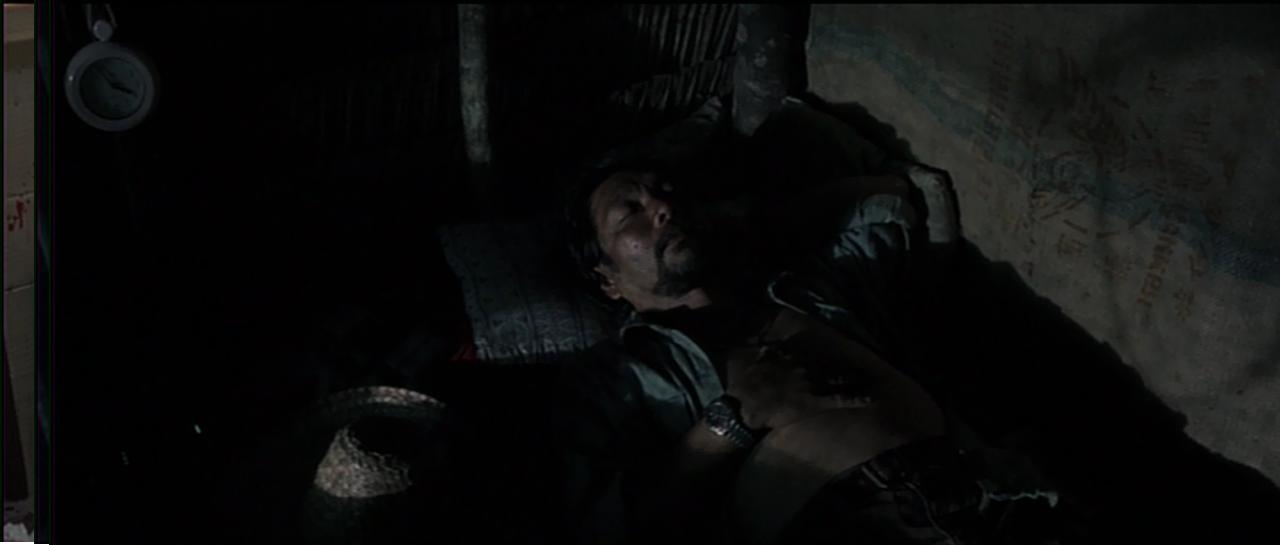
In this scene, Richard is playing a secret game with the dangerous farmers of the island as they sleep. It is clear that Richard is losing his sanity.
![]() |
| Again, the chiaroscuro lighting is used to only reveal part of Richard's face. His face is empty of emotion. |
![]() |
| The low angle shot here shows how Richard see's himself as of higher importance and more threatening than the island farmers. |
Saturday, 1 January 2011
Public Enemies analysis
This is the first 6 minutes of the Michael Mann film Public Enemies.
The film opens immediately to action, drama and fighting. The entire sequence, shown in the video, introduces the whole film as violent, aggressive and crime based. The first shot shows the feet of prisoners, chained together and being marched through the sand. The shot creates discomfort and immediately the sense of danger, as the action is in a prison, full of dangerous characters. The camera shots cut quickly, in time with the beat of the prisoners' march, between over-the-shoulder, close-up, low angle and long shots. The sounds are diegetic; the only sounds are from the chains and the prisoners' feet.
The first fighting that the audience see's begins when the prisoners are made to work. (1:42 - 3:12)
Again, Mann uses plenty of close up shots, including the close ups of the guns being passed around and the prisoner walking with a limp. The audience hears the sounds of the sewing machines working accompanied by slow string music whilst the audience prepares for the action about to unfold. A sudden surge high-pitched strings occurs when the first prisoner turns on one of the guards, increasing the tension of the moment.
The next scene of the prisoners includes the first kills of the film. (3:50 - 4:47)
This shot is particularly effective as it shows the violence from the guards' perspectives, behind the prison bars. As the prisoner attacks the guard on the left, the audience views it from behind the bars, as if a witness to the scene. It puts the audience in a vulnerable position, increasing suspense. Another brief shot of this action is a close up of the victims head on the ground as the baton hits it. It is graphic and disturbing, and used to shock the audience.
By using diegetic sounds, Mann keeps the sense of realism high within the action. The diegetic sounds heard are the shouts between prisoners and guards, the baton hitting the man, the grunts of the attacker, the character John Dillinger (Johnny Depp) shouting, and the sudden gunfire as a second guard is killed. This is followed by the chilling sound of a siren, which creates an feeling of panic.
Thursday, 30 December 2010
Thriller aspects from "If dogs run free" A touch of frost
The scene with thriller aspects is from 8:59 to 9:58 in this video and...
... Up to 00:14 in this video
The aspects of this scene of the thriller genre are the location and the action. This scene very closely resembles the idea for our thriller opening: the mugging of a woman in a deserted subway, by a hooded character.
The low angle of this shot makes the bike and the person on the bike more intimidating. The small size of the image of the woman makes her seem more vulnerable.
This shot reveals the danger that the woman is in. The chase keeps the pace fast, therefore keeping tension high. The subway walls are close together, creating a claustrophobic feeling.
This shot uses the rule of thirds to draw the eye to the action to the left of the screen. The vanishing point, being the entrance/exit to the subway, is also kept to the left of the scene, which makes it appear further away. This is effective as it shows that escape is difficult to reach.
The scene uses all low angle shots. This is effective by making the appear mugger greater and stronger, and making the victim seem much more vulnerable, increasing the tension. The chiaroscuro, dull lighting makes the picture almost black and white. It makes the colours cold and emotionless, keeping the sense of danger and discomfort high amongst the audience. The scene uses reverse shots throughout to keep the action fast-paced, like a pulse, creating connotations of fear.
We can use all of these methods for our mugging scene in our thriller opening the create the same amount of tension and suspense that this video creates.
The aspects of this scene of the thriller genre are the location and the action. This scene very closely resembles the idea for our thriller opening: the mugging of a woman in a deserted subway, by a hooded character.
This high angle shot presents the location as a dark, murky place, which is difficult to make out due to the lack of light. It creates an immediate sense of danger.
This shot introduces the underpass as a dangerous location. It looks run down and neglected, as well as isolated. The lighting is non-ambient and artificial, which makes the scene unnatural.
The low angle of this shot makes the bike and the person on the bike more intimidating. The small size of the image of the woman makes her seem more vulnerable.
This shot reveals the danger that the woman is in. The chase keeps the pace fast, therefore keeping tension high. The subway walls are close together, creating a claustrophobic feeling.
This shot uses the rule of thirds to draw the eye to the action to the left of the screen. The vanishing point, being the entrance/exit to the subway, is also kept to the left of the scene, which makes it appear further away. This is effective as it shows that escape is difficult to reach.
The scene uses all low angle shots. This is effective by making the appear mugger greater and stronger, and making the victim seem much more vulnerable, increasing the tension. The chiaroscuro, dull lighting makes the picture almost black and white. It makes the colours cold and emotionless, keeping the sense of danger and discomfort high amongst the audience. The scene uses reverse shots throughout to keep the action fast-paced, like a pulse, creating connotations of fear.
We can use all of these methods for our mugging scene in our thriller opening the create the same amount of tension and suspense that this video creates.
Sunday, 26 December 2010
Jackie Brown
The title sequence of the film introduces the main character, Jackie Brown. The audience doesn’t learn much about her from this, except that she is air hostess.
The next scene introduces another character: Ordell. The first impression of Ordell contrasts to that of Jackie Brown as the first shot is of the TV screen, and a programme called “Chicks who love Guns”. It is used effectively to introduce Ordell as womanising and violent, although later in the scene he is made to seem less dangerous by his girlfriend, who disobeys his somewhat and also claims that Ordell doesn’t really know what he is talking about.
This scene is the killing of Beaumont by Ordell. This is the first act of violence by Ordell that the audience sees and is used to create shock and surprise.
The composition of the camera shot is a metaphor for the personality of Ordell: it represents him as a psychopath. The image shows the audience that Ordell can distance himself from reality and his detached personality. The long distance means that the audience do not get a good view of the murdere; this also distances Ordell, and highlights the insignificance of Beaumont’s death. The pan shot, long distance and high angle of the camera all help to create the feeling of a witness over a fence.
The action shows the audience that he has no empathy, no mercy, and is very dangerous and manipulating. It also shows the audience that Beaumont is an insignificant person to Ordell.
Saturday, 6 November 2010
The Event - TV thriller series -
"When a man goes looking for his missing girlfriend, he stumbles upon a government conspiracy that is bigger than the president himself. "
The Event is a new American science fiction thriller TV series based on government conspiracy. The plot of the show centers around an extraterrestrial race who have been detained by the US government for 66 years, and may now become exposed to the public.
The TV series often has some generic thriller aspects. The cellar shots from episode 4 are particularly effective
The cellar scene has thriller aspects as it is a generic location. The cellar is dark, small and lonely.
The lighting of these shots give them thriller aspects. The director has used chiaroscuro lighting to only light up her face. This shows the emotions on her face, and also hides the scene around her which increases the tension felt by the audience as we can't see anything else. It also increases the sensation of the claustrophobia felt by the character of being trapped with no escape, and the darkness surrounding and suffocating her.
The rule of thirds is used by the director a lot in The Event. This can be particularly seen in pictures 1, 2, 3, 4, 6 and 7.
Notice the tilt shots in picture 7 and 8. These are fantastic shots showing both the victim and the hostage taker. They distort and confuse the audience of what's happening in the shot, especially with the little light, increasing the sense of danger and suspense.
The Event is a new American science fiction thriller TV series based on government conspiracy. The plot of the show centers around an extraterrestrial race who have been detained by the US government for 66 years, and may now become exposed to the public.
The TV series often has some generic thriller aspects. The cellar shots from episode 4 are particularly effective
![]() |
| Picture 1 |
![]() |
| Picture 2 |
![]() |
| Picture 4 |
![]() |
| Picture 5 This close up of the character's tied up hands is effective because it shows her struggle and further exaggerates the sense of claustrophobia. |
![]() |
| Picture 6 This shot uses chiaroscuro lighting to show the character in a vulnerable position. |
![]() |
| Picture 8 This shot has the same effect as Picture 7. |
![]() |
| Picture 10 This shot is used to show the vulnerability of the hostage, and desperation of her situation. |
The lighting of these shots give them thriller aspects. The director has used chiaroscuro lighting to only light up her face. This shows the emotions on her face, and also hides the scene around her which increases the tension felt by the audience as we can't see anything else. It also increases the sensation of the claustrophobia felt by the character of being trapped with no escape, and the darkness surrounding and suffocating her.
The rule of thirds is used by the director a lot in The Event. This can be particularly seen in pictures 1, 2, 3, 4, 6 and 7.
Notice the tilt shots in picture 7 and 8. These are fantastic shots showing both the victim and the hostage taker. They distort and confuse the audience of what's happening in the shot, especially with the little light, increasing the sense of danger and suspense.
Wednesday, 3 November 2010
This is the trailer for the new film "Buried"
"Paul is a U.S. contractor working in Iraq. After an attack by a group of Iraqis he wakes to find he is buried alive inside a coffin. With only a lighter and a cell phone it's a race against time to escape this claustrophobic death trap."
Below are some snapshots from the film:
Each of these pictures are successful in capturing the feeling of claustrophobia and sharing it with the audience.
All of the shots use chiaroscuro lighting to create the scene. Picture 1 is lit only by the flame of a lighter. The lighting is .... and is used to show the audience the space that the character is in, in order to increase the sense of claustrophobia and fear.
Picture 2 is lit by the light of a mobile phone. It particularly shows the face of the character close up, highlighting the cuts on his face. This shows the danger that the character is in.
On picture 3, the chiaroscuro lighting focuses the eye on the face of the victim, which reveals the emotion on his face. This helps to make the audience feel the terror that the character feels.
"Paul is a U.S. contractor working in Iraq. After an attack by a group of Iraqis he wakes to find he is buried alive inside a coffin. With only a lighter and a cell phone it's a race against time to escape this claustrophobic death trap."
Below are some snapshots from the film:
![]() |
| Picture 1 |
![]() |
| Picture 2 |
![]() |
| Picture 3 |
Each of these pictures are successful in capturing the feeling of claustrophobia and sharing it with the audience.
All of the shots use chiaroscuro lighting to create the scene. Picture 1 is lit only by the flame of a lighter. The lighting is .... and is used to show the audience the space that the character is in, in order to increase the sense of claustrophobia and fear.
Picture 2 is lit by the light of a mobile phone. It particularly shows the face of the character close up, highlighting the cuts on his face. This shows the danger that the character is in.
On picture 3, the chiaroscuro lighting focuses the eye on the face of the victim, which reveals the emotion on his face. This helps to make the audience feel the terror that the character feels.
Friday, 29 October 2010
Essex Boys
This is the opening scene to Essex Boys
The shot of the garage reveals an old, unused car, covered in cobwebs and dust. Billy has to clear his way through this to get to the car. It is as if he is pushing aside the bad in his life in a carefree way, and suggests naivety. Non- ambient, chiaroscuro lighting is used to keep the scene dark. It distorts the vision of the audience, not revealing the entire scene, keeping the tension high in this first shot. The sound is only diegetic – the garage door, the sound of billy stealing the car, the car starting.
As well as the diegetic sounds, Billy’s voice is heard narrating the action. It introduces his character, as well as his strong essex accent.
The darkness in this shot surrounds Billy, yet he seems unaware of it.
The first image of Jason that the audience see's is unclear, and partially obscured by the dust on the windscreen. It is also taken from Billy’s point of view, which suggests that what Billy see’s Jason as is also obscured and distorted.
This shot shows the journey to the market through the Dartford tunnel. The empty roads suggest a solitary mission for Jason. The chiaroscuro lighting of the tunnel represents darkness surrounding the characters. The rule of thirds is used here: the circle of the tunnel is positioned to the left of the frame, and the road markings draws the eye to the vanishing point of the image. It helps to suggest distence, journey and makes the audience feel as though they're going on the journey with the characters.
The lights reflecting on the windscreen of the car are useful imagery as they are metaphors of jail bars across Billy’s face. It introduces the audience to the theme of crime within the film.
Also notice the position that Jason is in in the back of the car. He is lounging on the seat, showing his relaxation. It shows how he is the figure of authority.
The fish market is quite a strange setting, but it is used as a typically British location. This scene shocks the audience and introduces Jason’s violent character early into the film.
The shot from the wing mirror is from Billy’s perspective. It represents the distorted, surreal image of Jason that he sees. It shows that Billy doesn’t understand Jason’s actions.
The director has used another typically British indicator – the white van. It is a symbol of crime as a typical getaway vehicle. The director has used this to emphasize the Essex characters.
This location is generic because it is a wide open space, deserted marsh. It appears cold, wet and in the middle of nowhere. The rule of thirds draws the eye to the horizon, which exaggerates the expanse of the place where Jason was leaving the man.
The high shot used here is used to put Jason at a vulnerable place, the opposite to how the audience has perceived him up until then. The lion statue is made of gold which is precious and valuable. Jason’s gold, scruffy shirt contrasts the lion effectively, further demeaning Jason. The angle of the shot also makes the lion look like it is staring right down at Jason, putting him in a lower position than the statue and therefore the owner of the house.
Once Upon a Time in America, Sergio Leone 1984
The first signifier of this film is the song "God bless America" sung in the background. This song's meanings and values are ironic, as the film shows a different side to America which contradicts with the song.
This image is a strong shot. It shows the elegance and beauty of the femme fatale, Eve. The hat positioned almost on the side of her head, her nail varnish and rings, and her pearl necklace shows she was very stylish. The pearls also indicate that she is a vulnerable character, as they are sybols of tears. The lighting is diegetic as the only light source is the lamp. The colour of the light makes the shot almost sepia, and matches perfectly to the colour of Eve's face and clothes, and the warmth she posseses.
The rule of thirds plays a big part in the success of this particular image, as does the depth of field. We see the three policemen characters, one to the far right to the image, closer to the camera than the other two, one to the left and the last in the middle, clearly brandishing a gun. The focus of the camera keeps the closest man out of focus, and the other two in focus. This helps to draw the viewer’s eye straight to the centre character, who is the important figure and also the only one seen with a weapon. The men are all looking slightly to the left of the camera, revealing all of their faces and the serious expressions they all share.
This image of the 3 authoritive figures standing over eve’s body after they shoot her is powerful as it shocks the viewer by showing, although out of focus and in the foreground, Eve’s lifeless body and face. Her eyes are especially shocking as we can see how they are staring blankly and lifelessly.
This shot, after the scene of Eve’s death, shows a lift shaft. This helps to build tension as the lift is a generic location for a thriller. It provokes the sensation of chlaustrophobia and entrapment, and heightens the feeling of danger within the scene.
The locker and the briefcase in this shot are more examples of generic conventions found in this film. The locker, like the lift shaft, can signify chlaustrophobia, but it also provokes mystery as to what is inside it, and furthermore what is inside the briefcase. It makes the viewer intrigued as to what's in the briefcase.
Subscribe to:
Posts (Atom)